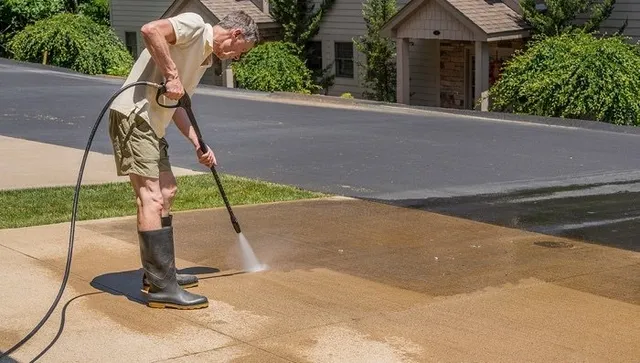
Few home maintenance projects offer the instant gratification of pressure washing a filthy concrete driveway. Watching years of accumulated tire marks, mildew, and Georgia red clay wash away under a stream of pressurized water feels like peeling back a layer of neglect to reveal brand-new masonry.
The trouble usually begins an hour after the water shuts off. As the concrete dries under the sun, that uniform gray slab transforms into an unsightly mess of alternating light and dark bands. Known across the exterior cleaning industry as tiger stripes or zebra striping, these streaks turn an afternoon of hard labor into an eyesore that neighbors can spot from down the block.
Tiger striping is not an inevitable side effect of cleaning concrete. It is an error in technique, tooling, and chemistry. Understanding why these streaks develop, how to operate your equipment properly, and why professional contractors rely on cleaning solutions rather than raw water pressure will keep your flatwork looking pristine, smooth, and uniformly bright.
What Causes Tiger Stripes on Concrete?
Tiger striping occurs when cleaning pressure is applied unevenly across a flat surface. On standard concrete flatwork, the phenomenon stems from three primary issues: erratic wand movement, inconsistent overlap, and surface etching caused by excessive hydraulic force.
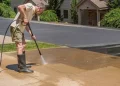
The most common culprit is the pendulum sweep. When using a standard handheld wand, the natural tendency is to stand in one spot and swing the spray gun back and forth from the hips or wrists. This movement traces an arc through the air. At the center of the arc, the nozzle dips closest to the ground, concentrating maximum pressure on a tiny strip of masonry. At the ends of the swing, the nozzle rises several inches higher, dispersing the spray pattern and reducing cleaning impact. Once the concrete dries, you are left with scalloped, curved bands where the wand cut deep in the middle and barely skimmed the edges.
A more permanent and devastating cause is aggregate etching. Concrete is not a solid block of uniform stone. It consists of coarse sand and gravel aggregate bound together by a thin, delicate top layer of cured Portland cement paste known as the cream layer or laitance. When an operator brings a high-pressure nozzle too close to the surface, the water jet acts like a chisel. It tears away that smooth top layer, exposing the rough aggregate underneath.
Etching is not a dirty spot that can be washed away; it is physical damage to the concrete itself. The etched gouges reflect sunlight differently and trap dirt much faster than the surrounding smooth areas, locking in those striped scars permanently.
Equipment Choices: Ditching the Wand for a Surface Cleaner
If you want to eliminate tiger stripes entirely, the single most effective upgrade you can make is putting down the hand wand and picking up a walk-behind rotary surface cleaner.
A handheld wand uses a single fan nozzle. Keeping that single nozzle at a perfectly consistent height of eight inches off the ground while maintaining a constant forward speed for hours across a five-hundred-square-foot driveway is physically impossible for the human body. Fatigue sets in within fifteen minutes, your arms droop, your pace stutters, and striping inevitably follows.
A rotary surface cleaner solves this mechanical challenge through fixed engineering. It features a circular housing fitted with a spinning spray bar underneath, driven by two opposing nozzles that rotate rapidly on a central swivel. Because the unit rests on rolling casters or hovers on a nylon bristle skirt, the nozzles remain locked at an identical height from the pavement at all times. The rapid circular rotation delivers thousands of overlapping cleaning passes every minute, creating an even, uniform finish that no handheld wand can match.
Matching your surface cleaner to your pressure washer is critical. If your machine cannot push enough water volume, the spray bar will spin too slowly, leaving circular swirls instead of a clean surface. A dependable industry rule of thumb is to allocate four inches of surface cleaner diameter per gallon per minute (GPM) of machine output. If your pressure washer produces 4 GPM, use a 16-inch surface cleaner. If you are running an entry-level consumer unit producing 2.5 GPM, stick to a 10-inch or 12-inch deck. Attempting to run a 20-inch commercial cleaner on a low-volume consumer pump chokes the rotation speed and virtually guarantees striping.
Proper Technique for Stripe-Free Flatwork
Even with the right gear, careless operation can still lead to uneven results. Consistent results require disciplined pacing, strategic coverage patterns, and controlled pressure.
Mastering the Overlap Pattern
When operating a surface cleaner, move at a steady, deliberate walking pace. Pushing the machine too fast outruns the rotation of the internal spray bar, creating a faint spiral pattern across your path.
Treat the flatwork like a freshly mown lawn. Push the cleaner forward in a straight line along the concrete expansion joints, stop, step over, and pull it back along the adjacent lane. Crucially, you must overlap each pass by at least 25 to 30 percent. This overlap compensates for the slightly lighter cleaning strike at the outer perimeter of the circular housing, ensuring that every square inch of masonry receives equal agitation.
If a driveway is heavily neglected or laden with deep mildew, implement a cross-hatch pattern. Clean the entire area in north-south passes, rinse the loose sludge away, and then make a second, lighter pass moving east-west. This perpendicular pattern breaks up any directional shadows and erases faint lines before they dry.
Restricting Wand Use to Edges and Expansion Joints
The handheld wand still has a place, but its role should be strictly confined to detail work. Use the wand to cut in along garage door thresholds, brick foundations, landscaping borders, and around downspouts where the round deck of a surface cleaner cannot reach.
When using the wand, equip it with a 25-degree green tip or a 40-degree white tip. Never use a 0-degree red pencil tip on concrete, as it behaves like a razor blade against the cream layer. Lock your wrists and elbows, keeping the nozzle tip between ten and twelve inches off the pavement. Move your entire torso forward and backward with steady steps rather than pivoting your arms. Feather your strokes at the end of each pass by releasing the trigger before you stop moving, preventing pressure spikes on turnaround points.
Dialing in Pressure and Respecting Curing Times
More pressure does not equate to better cleaning. High water volume washes away dirt; excessive pressure destroys materials.
For mature concrete that has been in place for more than three years, keep working pressure between 2,500 and 3,000 PSI. Anything approaching 4,000 PSI at close range risks pitting and spalling the top finish.
If concrete is newly poured, leave the pressure washer in the garage. New concrete requires months to achieve its full compressive strength and harden its surface layer. Applying high pressure to concrete that is less than one to two years old will strip the cream layer clean off, ruining the driveway before it ever sees its first harsh winter. Clean new concrete using soft washing techniques and low-pressure rinses only.
The Secret Weapon: Pre-Treating and Post-Treating
Professional exterior cleaners rarely rely solely on water pressure to clean concrete. Instead, they let cleaning solutions break down the bond between contaminants and the masonry pores before any high-pressure equipment touches the slab.
Concrete is naturally porous, functioning like a dense, mineral-rich sponge. Organic growths such as algae, mold spores, and lichen do not merely sit on top of the slab; their microscopic root systems penetrate deep into the pores. A surface cleaner running plain water shears off the visible heads of these plants, but leaves the root structures lodged inside. Those hidden roots cause the concrete to dry unevenly and allow green growth to return within weeks.
Pre-treating the driveway with a dedicated cleaning solution—typically a diluted sodium hypochlorite mix blended with a surfactant—kills organic matter on contact. Applying this mix through a chemical injector or dedicated pump sprayer breaks surface tension, melts oil films, and liquefies algae. When you follow up with the surface cleaner, the machine only needs to sweep away dead material rather than mechanically grinding off living growth.
Even more crucial for avoiding tiger stripes is the post-treatment. After you have surfaced-cleaned the flatwork and thoroughly rinsed all dirty slurry into the street or yard drains, mist a light, even coat of your cleaning solution over the damp concrete. Do not rinse this final application away; let it dry naturally into the slab.
A post-treatment serves as an insurance policy. It bleaches out minor color inconsistencies, lifts faint overlap shadows, sterilizes remaining spores deep in the pores, and ensures that the entire driveway cures to a crisp, uniform brightness as the sun dries it out.
How to Fix Existing Tiger Stripes
If you are reading this after the fact and your driveway already looks like a zebra, do not panic. How you remedy the problem depends on whether the lines are made of lingering dirt or structural gouges.
Conduct a close visual inspection. If the darker stripes feel identical in texture to the lighter areas when you run your hand across them, the problem is uneven cleaning. The dark bands are simply residual dirt and organic roots that were missed during the first pass.
To correct dirt striping, saturate the entire area with a stronger chemical pre-treatment and let it dwell for fifteen minutes without drying. Then, run your surface cleaner over the slab in a direction perpendicular to the original striping pattern, keeping your overlap wide and your pace steady. Follow with an immediate rinse and a thorough post-treatment. The cross-cut mechanical action combined with chemical bleaching will blend the two zones together.
However, if the light stripes feel rough, sandy, and pitted while the dark bands feel smooth, the concrete has been etched by excessive pressure. Water and chemicals cannot replace stone that has been stripped away. In cases of minor surface etching, a post-treatment can brighten the darker, unetched areas to make the visual contrast less glaring. For severe etching where deep grooves have been cut into the slab, the only true remedies are professional resurfacing with an engineered micro-topping or applying a pigmented concrete stain to establish an even color profile across the damaged aggregate.
Patience, consistent tool geometry, and proper chemical treatments will always outperform sheer, unbridled water pressure on residential masonry. By stepping away from erratic wand techniques, matching your surface cleaner to your pump’s flow rate, and letting cleaning solutions do the hard lifting, you can wash driveways and sidewalks with confidence, leaving behind a smooth, spotless surface that looks expertly finished from every angle.