A clogged gutter on a single-story ranch house is a minor weekend chore. On a two-story home, that same chore turns into an exercise in high-altitude risk management. At twenty to twenty-five feet in the air, a momentary slip, an unstable ladder foot, or a sudden gust of wind carries catastrophic consequences. Yet leaving those troughs packed with decaying leaves, pine needles, and roof grit is not an option. Overflowing water rots wooden fascia boards, cracks foundation walls, breeds mold inside exterior wall cavities, and backs up under the roof deck to cause expensive structural leaks.
Homeowners facing second-story rooflines need reliable strategies that balance thorough cleaning with absolute personal safety. Fortunately, you do not have to gamble on a wobbly ladder perch to maintain your drainage system. Modern maintenance methods fall into two primary paths: working smart from the absolute safety of solid ground, or using specialized gear and strict rigging protocols when an elevated approach is necessary.
Ground-Based Cleaning Methods: Eliminating Fall Risks Entirely
The safest way to clean elevated gutters is to keep both boots planted firmly in the yard. In recent years, advances in telescoping poles, lightweight carbon-composite tubing, and purpose-built gutter attachments have made ground-based cleaning practical for two-story properties. While ground methods require physical stamina and some patience to navigate around landscaping, they eliminate the single greatest hazard of the task.
Telescoping Gutter Vacuum Attachments
Rigid, curved vacuum extensions connected to a high-capacity wet/dry vacuum represent one of the cleanest ways to extract dry and semi-dry organic matter. These kits consist of interlocking aluminum or carbon fiber pole sections capped with a 180-degree U-bend nozzle.
To work effectively on a second story, the vacuum unit requires serious suction power. A standard household vacuum cannot lift damp muck twenty feet through a hose; you need a commercial-grade wet/dry vacuum rated at least five to six peak horsepower with a two-and-a-half-inch diameter hose to prevent constant clogging.
The primary challenge of vacuuming from below is visibility. Operators work blind unless they incorporate modern visual aids. Many homeowners pair telescoping poles with an inexpensive, lightweight wireless inspection camera or a smartphone secured in a specialized cradle near the nozzle. Transmitting a live video feed to a phone mounted at handle height lets you see precisely where dense packs of decomposed leaves sit, ensuring you do not leave packed dirt behind.
High-Pressure Water Wands
When debris has turned into heavy, wet muck, vacuum attachments can struggle to lift the sludge. In these situations, telescoping water flushers offer a practical alternative. These wands hook up to an outdoor garden hose or, for stubborn buildup, an electric pressure washer configured with a specialized low-pressure flusher tip.
A water wand features an angled brass nozzle designed to blast water horizontally down the length of the trough toward the downspout drop outlet. Because water adds substantial weight to an extended pole, look for models featuring rigid fiberglass or aircraft-grade aluminum sections with secure cam locks.
Be prepared for mess. Flushing gutters from the ground inevitably sends dirty runoff over the gutter lip. You should cover valuable shrubbery, outdoor air conditioner condensers, and delicate porch furniture with heavy-duty drop cloths before turning on the water. Work systematically toward the downspouts, taking short breaks to prevent shoulder and lower-back fatigue from stabilizing the upright pole against hydraulic kickback.
Telescoping Leaf Blower Attachments
If you clean your gutters early in autumn before seasonal rains soak the canopy, dry leaves can be removed rapidly using curved blower tubes. Many outdoor power equipment brands sell rigid, snap-together blower extensions designed specifically for gutter maintenance.
This approach works best on fresh, uncompacted leaf fall. The key is rhythm: walk along the perimeter of the home holding the blower steady, letting the directed air current roll the dry debris along the channel and out over the end caps or low sections. Protective safety glasses, a hard hat, and an N95 dust mask are mandatory when using this technique, as pulverized roof granules, dried bird droppings, and mold spores shower down in substantial clouds.
Ladder-Based Strategies: Doing It Safely When Altitude Is Unavoidable
Ground-based tools work well for routine maintenance, but they have limitations. They cannot easily loosen compacted asphalt shingle gravel that has cemented into a heavy dam, nor can they secure loose gutter spikes or inspect hidden sealants. When you must climb to gutter height, safety depends entirely on using professional-grade access equipment and obeying strict ladder physics.
Selecting the Proper Extension Ladder
Never attempt to reach a second-story roofline with a standard step ladder, a multi-position ladder configured past its safe height, or a worn-out aluminum extension ladder. Reaching an eave height of twenty feet requires a Type 1A (300-pound duty rating) or Type 1AA (375-pound duty rating) extension ladder with a nominal length of twenty-eight feet.
A common mistake is buying a ladder that matches the exact height of the roof. Ladder geometry requires an overlap between fly and base sections, plus the ladder must extend at least three feet above the working point if stepping off onto a flat landing, or provide sufficient reach so you never work from the top three rungs.
Always adhere to the four-to-one rule of ladder placement. For every four feet of vertical height between the ground and the upper contact point, place the ladder base one foot away from the wall. If your ladder rests against the wall at twenty feet, the base must sit precisely five feet away from the structure. A ladder pitched too steep will tip backward when your center of gravity shifts; a ladder pitched too shallow will slide out at the base under your weight.
Using a Ladder Standoff Stabilizer
Resting a ladder directly against fragile aluminum or vinyl gutters is dangerous and destructive. The pressure can crush the gutter troughs, crack hidden mounting brackets, or cause the ladder rails to slide along the slick metal lip.
A ladder standoff bracket, also called a ladder stabilizer, is an essential safety accessory. These tubular steel or aluminum attachments mount securely to the top rungs, spanning three to four feet wide with heavy rubber bumper pads. The standoff holds the ladder roughly twelve inches away from the home, allowing the rungs to rest against the exterior siding, roof decking, or window trim rather than the gutter itself. This wide stance dramatically increases lateral stability, virtually eliminating the terrifying side-to-side wobble that causes ladder falls.
Securing Ground Footing
Second-story ladder accidents almost always originate at the base. Before raising the ladder, inspect the ground for soft topsoil, muddy turf, landscaping mulch, or uneven concrete joints.
On soft turf, flip the ladder feet to their spurred, spiked position and drive them deep into the soil. If the terrain slopes, never level the ladder by slipping scrap 2×4 lumber or loose bricks under one foot. Unsecured shims easily shift and kick out under load. Invest in bolt-on mechanical ladder levelers, which feature micro-adjustable legs that lock solidly into place on unlevel ground. Whenever possible, have an adult helper foot the ladder at the base during your climb, or anchor the bottom rung to permanent landscape features using heavy ratchet straps.
Ergonomics and the Three-Point Rule
Once positioned at working height, maintain three points of contact at all times: two feet on the rungs and one hand on a rail, or two hands on the rungs and one foot planted. Keep your belt buckle centered between the side rails. The moment your belt buckle crosses outside the rail line, your center of gravity shifts, and the ladder can kick sideways instantly.
Overreaching is the number one cause of ladder falls during gutter cleaning. Clean only the section directly in front of you and comfortably within an arm’s reach. Climb down, reposition the ladder ten feet down the line, reset the level, and climb up again. The extra trips up and down the ladder may take more time, but they preserve your life.
Use a simple bucket hanger hook to suspend a collection bucket from the ladder rung or roof edge, leaving both hands free to work and steady yourself. Never attempt to hold a heavy bag of wet leaves while balancing on a high rung.
Clearing Stubborn Downspout Clogs
A spotless horizontal gutter channel is completely useless if the vertical drop outlet and downspout are packed solid. Clogged downspouts hold standing water that freezes in winter, expanding and splitting the metal seams, while providing a breeding ground for mosquitoes in summer.
If water does not flow freely down the pipe, address the blockage from the ground up:
-
Remove the downspout elbow at ground level: Unscrew the sheet metal screws securing the bottom curved elbow where the pipe discharges into the yard or underground drain basin.
-
Insert a standard drum auger: Feed a manual plumber’s snake up through the bottom of the downspout. Crank the handle to chew through the dense plug of compacted maple seeds and decomposed sludge, pulling the debris downward where gravity aids removal.
-
Flush with a high-pressure hose bladder: Insert a garden hose fitted with an expandable rubber drain-cleaning bladder into the bottom opening. The bladder expands to seal the pipe, while pulsating water jets force the clog upward and backward out of the top outlet or break it into flushable fragments.
If the clog sits right at the top drop outlet, use a telescoping hook from the ground or clear it during a properly secured ladder run using a specialized gutter scoop. Never push large, solid debris down into the downspout, as it will inevitably jam at the internal seams of the second-story elbows.
Structural Improvements to Minimize Future Maintenance
Constantly balancing on a tall ladder or wrestling high-pressure poles every spring and fall is demanding. Homeowners can drastically reduce how often they face this chore by upgrading the gutter system itself.
Installing High-Performance Gutter Guards
Gutter guards do not eliminate maintenance entirely, but they turn a four-times-a-year ordeal into a brief checkup every few years. Avoid cheap plastic snap-in screens or foam inserts; pine needles wedge easily into plastic mesh, and foam filters quickly rot into a damp bed where weed seeds sprout.
For second-story applications, look at micro-mesh guards made with surgical-grade stainless steel wire cloth mounted to rigid aluminum frames. These systems keep out everything down to fine asphalt shingle sand and pine needles while allowing high-volume rainfall to slip freely into the trough. Because debris cannot enter the channel, dry leaves sit on top of the mesh until natural crosswinds blow them off the roofline.
Upgrading Downspout and Trough Capacities
Many two-story homes come standard with undersized five-inch K-style gutters and narrow two-by-three-inch downspouts. These small downspouts choke on the slightest cluster of twigs.
When it comes time to replace your roof or gutters, upgrade to six-inch seamless aluminum troughs paired with three-by-four-inch commercial downspouts. The larger downspout opening provides more than double the cross-sectional drainage capacity of a standard residential pipe, allowing twigs, oak tassels, and large leaves to wash through cleanly without jamming in the high elbows.
Knowing When to Call the Professionals
While DIY methods provide independence and save on labor costs, there are scenarios where doing the job yourself is simply not worth the risk. Recognizing when your home exceeds safe DIY thresholds is a core part of responsible homeownership.
You should hire a licensed, insured gutter cleaning service if your property involves:
-
Walkout basements or steep grading: A two-story home built on a sharp hillside often has eaves thirty to thirty-five feet above ground level at the rear walkout. Standard consumer extension ladders cannot safely service these heights.
-
Complex roof geometries: Mansard roofs, multi-tiered turret roofs, or layouts with limited flat ground prevent proper ladder positioning and standoff placement.
-
Proximity to overhead power lines: Aluminum ladders and wet telescoping poles conduct electricity instantly. If service drops or power lines run anywhere near your eaves, keep clear and leave the job to utility-certified specialists.
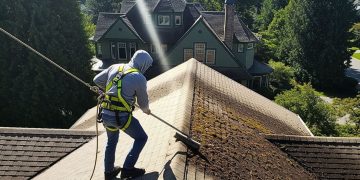
Professional exterior cleaning contractors arrive with articulating boom lifts, specialized fall-arrest harnesses that anchor directly to the roof ridge, and high-volume truck-mounted extraction vacuums. Spending a modest fee once or twice a year is a tiny price to pay when weighed against the life-altering reality of a twenty-foot fall.
Routine maintenance protects the structural integrity of your home, but it should never come at the expense of your physical safety. Choose reliable ground-based tools for seasonal maintenance, adhere to rigorous ladder safety whenever climbing is required, and step aside for professional crews when terrain or height pushes past your comfort zone.